On November 1, 2026, just two days before the U.S. midterm elections, we experience the Last Quarter Moon in Leo.
The elections take place on November 3, at a time when Americans are facing growing concerns about the cost of living, artificial intelligence, job security, energy consumption, and climate change.
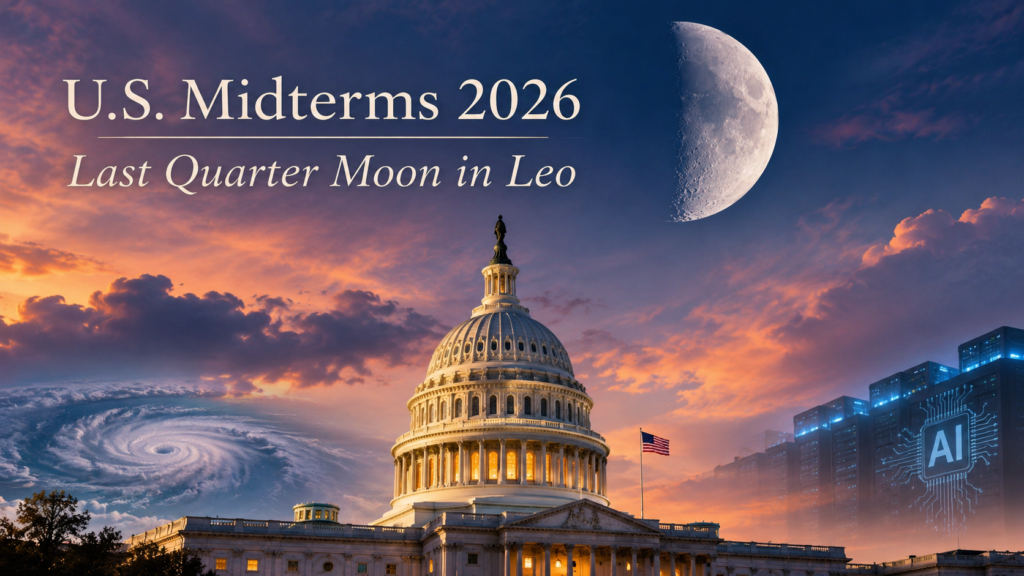
Meanwhile, a potentially powerful El Niño is developing, adding another layer of uncertainty to an already unpredictable world.
Looking at the astrological chart for Washington, D.C., this Last Quarter Moon brings up some interesting themes.
Who holds the power? Who benefits from progress? And what happens to ordinary people along the way?
The Last Quarter Moon in Leo: Power and the People’s Voice
The Last Quarter Moon occurs when the Sun and Moon form a 90-degree square.
In astrology, this lunar phase represents reflection, reassessment, and the need to let go of what no longer serves us.
This time, the Sun is in Scorpio and the Moon is in Leo.
Leo symbolizes leadership, pride, self-expression, and authority. Scorpio is associated with power, control, hidden motives, and transformation.
Both are fixed signs, known for their determination and reluctance to compromise.
When we look at the chart calculated for Washington, D.C., the symbolism becomes even more interesting.
Saturn and Neptune are positioned in an area associated with the nation and its people, suggesting themes of responsibility, limitations, ideals, and uncertainty.
Pluto, the planet associated with deep transformation and power structures, occupies the area traditionally connected with legislative bodies and collective goals.
From a mundane astrology perspective, these placements invite us to reflect on the relationship between political power and the public.
Are existing systems serving the people they are supposed to represent?
And how much change is necessary before ordinary citizens can feel that their voices truly matter?
Of course, astrology cannot scientifically predict election results. But it can offer a symbolic framework for reflecting on the issues of our time.
Election Day: Economic Security and Information
By November 3, the Moon moves into Virgo.
The atmosphere shifts symbolically from Leo’s passion and pride toward Virgo’s emphasis on practical concerns, details, and analysis.
In the Washington, D.C. chart calculated for noon on Election Day, the Moon occupies the eighth house, traditionally associated with shared resources, debt, taxation, and financial dependency.
It also forms a challenging square with Uranus, the planet of disruption, innovation, and unexpected change.
Uranus is positioned in the fourth house, associated in mundane astrology with land, housing, and the foundations of a nation.
This combination brings to mind concerns about financial security, housing affordability, and the stability of everyday life.
Another interesting feature is retrograde Mercury near the Midheaven, a point associated with government, leadership, and public authority.
Mercury symbolizes communication, information, documents, and the exchange of ideas.
In the context of an election, this naturally raises questions about transparency, accurate information, and public trust.
This does not mean that Mercury retrograde predicts election fraud, counting errors, or political unrest.
Rather, the symbolism reminds us how important reliable information and accountability are during an election.
El Niño and an Increasingly Unpredictable Climate
Politics is not the only source of uncertainty.
The climate is changing, too.
According to NOAA’s October 2026 outlook, El Niño is strengthening, with the possibility of becoming an exceptionally powerful event.
El Niño itself is nothing new. It is part of a natural climate cycle that has existed for thousands of years.
However, the oceans have also been absorbing enormous amounts of heat as a result of global warming.
That means natural climate fluctuations are now occurring against the background of a warmer planet.
Floods, droughts, wildfires, and extreme weather events continue to affect communities around the world.
Not every disaster can be attributed to El Niño or climate change alone, of course.
But when homes are destroyed, crops are damaged, and infrastructure must be rebuilt, the costs eventually reach ordinary households through food prices, insurance premiums, taxes, and other expenses.
Climate change is no longer just an environmental issue. It is also an economic and social issue.
AI Data Centers: Who Pays for All That Electricity and Water?
Another issue that has been bothering me lately is the rapid expansion of AI data centers.
We are constantly hearing about how artificial intelligence will revolutionize productivity, transform industries, and eventually free human beings from the need to work.
But all that computing power requires enormous amounts of energy.
According to the International Energy Agency’s 2026 outlook, global data center electricity consumption is projected to rise from approximately 485 terawatt-hours in 2025 to around 950 terawatt-hours by 2030.
That is nearly double in just five years.
And those figures include conventional data centers, not only AI facilities.
Depending on the cooling technology, data centers can also require significant amounts of water. Manufacturing semiconductors and constructing facilities consume additional natural resources.
Of course, more efficient technology, renewable energy, and improved cooling systems could reduce some of these environmental impacts.
But if AI usage continues to expand dramatically, how much electricity, water, and raw materials will ultimately be needed?
And who will pay for the infrastructure required to support it?
Companies may benefit from increased productivity and profits, but local residents could face added pressure on electricity supplies, water resources, and infrastructure.
The people receiving the profits and the people bearing the costs are not necessarily the same.
That is something worth questioning.
Universal High Income? I Have My Doubts
I recently heard about the concept of Universal High Income, promoted by Elon Musk.
The idea is that AI and robots will eventually perform most human labor, making goods and services so abundant that everyone can enjoy a high standard of living without needing a traditional job.
What a wonderful future that would be!
No more worrying about work, bills, or retirement. We could spend our time traveling, pursuing hobbies, and enjoying life.
But I have to admit, I am skeptical.
Looking at history and the way wealth is currently distributed, I find it difficult to imagine that the enormous profits generated by AI will automatically be shared with everyone.
Just because machines can produce wealth doesn’t mean the people who lose their jobs will receive any of it.
Consider Waymo, the autonomous taxi service.
As self-driving taxis expand, some Uber and Lyft drivers could see their work opportunities decline.
But is Waymo going to provide those displaced drivers with enough income to support themselves for the rest of their lives?
I seriously doubt it.
After investing enormous amounts of money into developing autonomous driving technology, companies naturally have incentives to recover those costs and generate profits.
That doesn’t mean they cannot provide transition assistance or that governments cannot establish income-support programs.
But a temporary assistance program is a very different thing from a guaranteed high income for everyone.
The real question is:
If AI replaces human labor, who is responsible for supporting the humans who no longer have jobs?
Will governments introduce universal income programs before widespread job displacement occurs?
Or will people first have to exhaust their savings, accumulate debt, and struggle to keep their homes before society finally responds?
I certainly hope it won’t be the latter.
But I cannot help wondering.
Are We Heading Toward a Future Like Brazil?
Thinking about all this reminds me of the 1985 dystopian film Brazil, directed by Terry Gilliam.
The movie portrays a society dominated by an enormous bureaucratic system, where technology and government control have become deeply intertwined.
Despite all the machinery and sophisticated systems, ordinary people are hardly living happy, comfortable lives.
Instead, they are trapped in a confusing, oppressive world where individual freedom is limited and bureaucratic mistakes can ruin lives.
The protagonist escapes into dreams of freedom and happiness.
I won’t spoil the ending here, but it is certainly not the cheerful vision of the future that technology companies like to promote.
More than 40 years after its release, Brazil feels strangely relevant.
Sometimes I wonder whether our future might resemble that film more than the optimistic promises of Universal High Income.
Imagine a society where AI and robots do most of the work, yet wealth becomes increasingly concentrated among a small group of owners and investors.
Ordinary people might live in increasingly cramped spaces, relying on limited public assistance.
Meanwhile, immersive virtual worlds could offer luxurious homes, exotic vacations, and endless entertainment.
Everyone could experience a wealthy lifestyle — virtually.
Perhaps for a monthly subscription fee.
How wonderful!
Reality might become less comfortable while the digital illusion of prosperity becomes more convincing.
It sounds like a combination of Brazil and The Matrix.
Of course, this is speculative, not a prediction. But it raises an important question about the difference between genuine freedom and an illusion of freedom.
Do We Really Need Universal High Income?
Living in Los Angeles, I have increasingly felt that maintaining an ordinary lifestyle requires more and more money.
Young adults struggle to afford independent housing.
Older workers worry about whether they can ever retire.
Dining out, traveling, and even simple entertainment can feel increasingly expensive.
Meanwhile, billions of dollars are being invested in AI, robotics, and massive data center projects.
Technological progress is impressive, but what good is it if ordinary people cannot enjoy the benefits?
Perhaps what we really need is not Universal High Income, but something simpler.
Universal Decent Life.
A society where everyone can afford a safe home, nutritious food, healthcare, and some leisure time.
Where young people can become independent and older people can retire without constant financial anxiety.
Where people have the freedom to make choices about their own lives.
And where technological progress does not come at the expense of the environment or the well-being of ordinary citizens.
We don’t all need to become millionaires.
We just need a reasonable opportunity to live comfortably and with dignity.
That shouldn’t be such an outrageous expectation, should it?
What Is the Last Quarter Moon Asking Us to Reconsider?
Returning to the astrology, the Last Quarter Moon in Leo symbolizes a moment of reassessment.
Leo represents leadership and authority, while Scorpio brings attention to power, control, and transformation.
The Election Day chart adds symbolism related to economic security, national foundations, and information.
These planetary configurations do not determine political events or election outcomes.
But as symbolic themes, they fit some of the questions facing society today.
Who controls the resources?
Who benefits from technological progress?
Who bears the environmental and financial burdens?
And ultimately, who gets to enjoy the prosperity that society creates?
The 2026 U.S. midterm elections take place amid significant economic, technological, and environmental uncertainty.
Whatever the election results, these questions will remain.
I sometimes wonder whether I have become too pessimistic about the future.
Perhaps AI really will create an age of abundance, with better healthcare, shorter working hours, and greater opportunities for everyone.
I would be delighted to be proven wrong.
But until someone explains exactly how those enormous technological profits will be distributed, I remain unconvinced by promises of a Universal High Income.
For now, I would happily settle for a Universal Decent Life.
A future where ordinary people can live with dignity, enjoy their lives, and feel secure about tomorrow.
And ideally, one where the planet gets a little breathing room, too.
After all, if AI is supposed to give humanity a break from working, perhaps we should consider giving Mother Earth a break as well.
Unfortunately, neither the Last Quarter Moon nor Mercury retrograde is going to pay our electricity bills.