
A major lunar eclipse is coming on August 27–28.
According to NASA, this one will be a partial lunar eclipse, visible across a wide area including the Americas, Europe, Africa, and Western Asia.
But “partial” doesn’t mean the Moon will be missing just a tiny sliver.
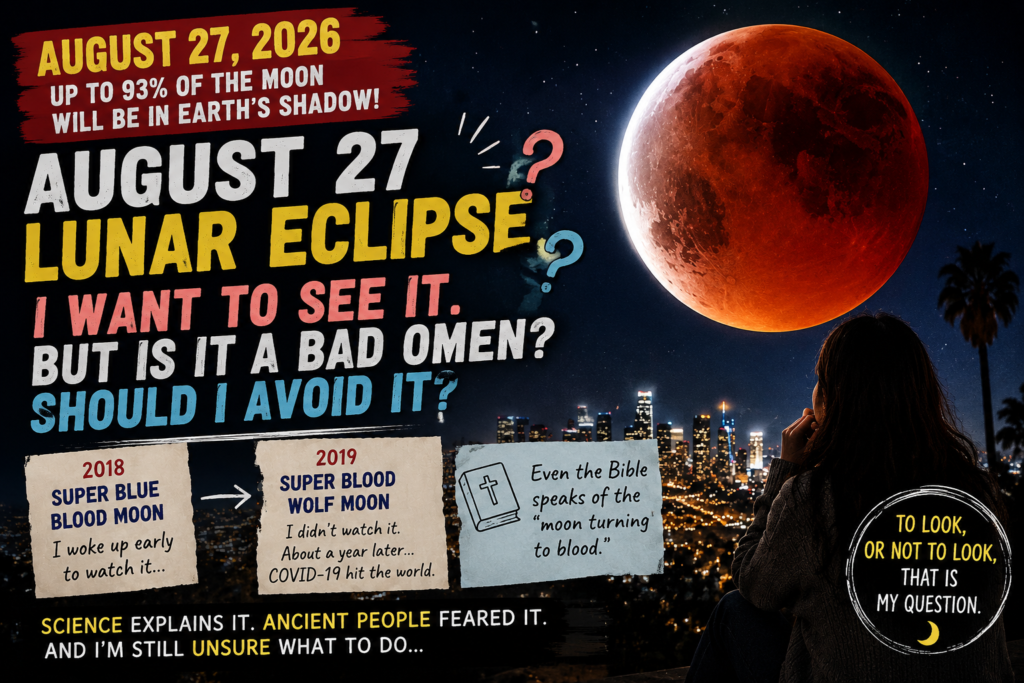
In Los Angeles, the partial eclipse begins at around 7:33 p.m. after moonrise and reaches its maximum at around 9:12 p.m. About 93% of the Moon will enter Earth’s umbral shadow.
That’s practically the whole thing.
Even Griffith Observatory is calling this event a “Partial Practically Total Lunar Eclipse.”
Scientifically, of course, we know exactly what is happening. The Sun, Earth, and Moon line up, and the Moon passes through Earth’s shadow. Unlike a solar eclipse, a lunar eclipse is perfectly safe to look at with the naked eye. The reddish color can also be scientifically explained: red and orange wavelengths of sunlight pass through Earth’s atmosphere and reach the Moon.
I know all that.
I really do.
But still…
I’ve Actually Woken Up Early Just to Watch One Before
When I heard about this lunar eclipse, something suddenly came back to me.
On January 31, 2018, there was the:
“Super Blue Blood Moon.”
It was a combination of a supermoon, blue moon, and total lunar eclipse, so naturally it received a lot of attention. NASA even broadcast the event from locations including Griffith Observatory in Los Angeles.
I was living in Los Angeles at the time, and…
I actually woke up in the middle of the night and went outside early in the morning just to see it.
I mean, if you give something a catchy name like “Super Blue Blood Moon,” how am I supposed to not be curious?
So even though I was sleepy, I got up, went outside, and…
I looked.
And when I think back on it now, the next several years turned out to be a pretty difficult period in my life.
Of course, there is absolutely no scientific evidence that:
I went through difficult times because I watched a lunar eclipse.
If you tell me it was just a coincidence, I can’t argue with that.
Still, when I hear that lunar eclipses have historically been regarded as ominous events in many cultures around the world, a little voice inside me starts saying:
“Maybe you don’t need to go out of your way to watch this one?”
Then Came the “Super Blood Wolf Moon” in 2019
The following year, in January 2019, there was another total lunar eclipse called the:
“Super Blood Wolf Moon.”
I didn’t watch that one.
And about a year later, the world was turned upside down by COVID-19.
…Okay.
A whole year had passed, so blaming the lunar eclipse for COVID would obviously be quite a stretch.
If we start thinking that way, we can probably find some terrible event somewhere in the world after virtually every lunar eclipse.
Globally, there are generally zero to three lunar eclipses per year, with around two being common. Some years don’t have a total lunar eclipse at all.
And if our standard becomes:
“Lunar eclipse happens somewhere in the world → something terrible happens within the following year,”
we’re almost guaranteed to find something.
Wars. Natural disasters. Pandemics. Financial crises…
Give yourself an entire year and you’ll have plenty to choose from.
And yet…
I still can’t completely laugh off the ancient belief that:
“A lunar eclipse is an ominous sign.”
The Bible Also Talks About the Moon Turning to Blood
This time, I happened to be reading one of the news stories that popped up on my Microsoft computer when I came across an article suggesting something along the lines of:
“Could this lunar eclipse be the one described in the Bible?”
The Bible does, in fact, contain references to the Moon becoming “like blood.”
The Book of Joel, Acts, and Revelation all contain imagery involving the Sun becoming dark and the Moon turning to blood.
That certainly doesn’t mean there is evidence that the August 2026 lunar eclipse is the fulfillment of a biblical prophecy.
But I can understand why people become curious when something we now call a “Blood Moon” is connected with ancient descriptions like these.
Why Were Ancient People So Afraid of Lunar Eclipses?
Today, we understand how lunar eclipses work.
But imagine being alive thousands of years ago.
You’re looking up at an ordinary full moon when suddenly it begins to disappear.
It gets darker.
Then it starts turning a strange reddish-black color.
And nobody is there to tell you:
“Don’t worry. The next one will happen on such-and-such date at exactly 9:12 p.m.”
Of course it would have been frightening.
Is something about to happen to the king?
Is the kingdom in danger?
Are the gods angry?
Is there going to be a natural disaster or a war?
It isn’t hard to understand why people might have interpreted such a dramatic change in the night sky as a warning.
Perhaps that is why traditions developed in various parts of the world advising people not to look at an eclipse, not to go outside during one, or not to expose themselves to the Moon’s light.
So… What Am I Going to Do This Time?
And here is my dilemma.
Back in 2018,
I deliberately woke up early in the morning just to see it.
This time, I don’t even have to make that kind of effort.
In Los Angeles, the eclipse happens on the evening of August 27.
By the time the Moon rises, the eclipse will already be underway, with the maximum occurring at around 9:12 p.m.
I’ll be awake anyway.
It’s exactly the kind of time when I might walk outside and accidentally see it.
And more than 90% of the Moon will be in shadow.
So…
I want to see it.
The curious part of me says:
“Come on. What’s the harm in taking a quick look?”
But then the part of me that remembers 2018 says:
“You went out of your way to wake up and watch the last one, and the years that followed weren’t exactly wonderful. Maybe just leave this one alone?”
Scientifically, there is nothing wrong with watching it.
There is no scientific evidence that being exposed to moonlight during an eclipse brings bad luck.
But when I remember how long people throughout history have regarded lunar eclipses as somewhat ominous events, I find myself thinking:
Maybe I don’t really need to go out and bathe in the moonlight this time.
Maybe I’ll just close the curtains.
But then 9:12 p.m. will roll around, and I’ll probably be sitting there thinking:
“It’s at maximum eclipse right now…”
And I have a feeling I might end up taking just a tiny peek through the curtains.
I want to see it. But something tells me maybe I shouldn’t.
I guess I have until the evening of August 27 to decide.