The Pisces lunar eclipse has come and gone, and somehow it’s almost September 2026 already. It’s been another turbulent year… though honestly, it feels like I say that every year lately. What actually happened? Let me trace it back from the most recent events.
The Economic Mood
2026 has been a year of stocks dipping and climbing back up, over and over. People who’d been steadily investing in index funds like the All-Country World fund or the S&P 500 caught some lucky stretches. But underneath it all, inflation kept climbing, and the same question hung in the air the whole time: “just how long are we supposed to put up with this?”
August: Nature’s Fury and a Distant Fight Over Justice
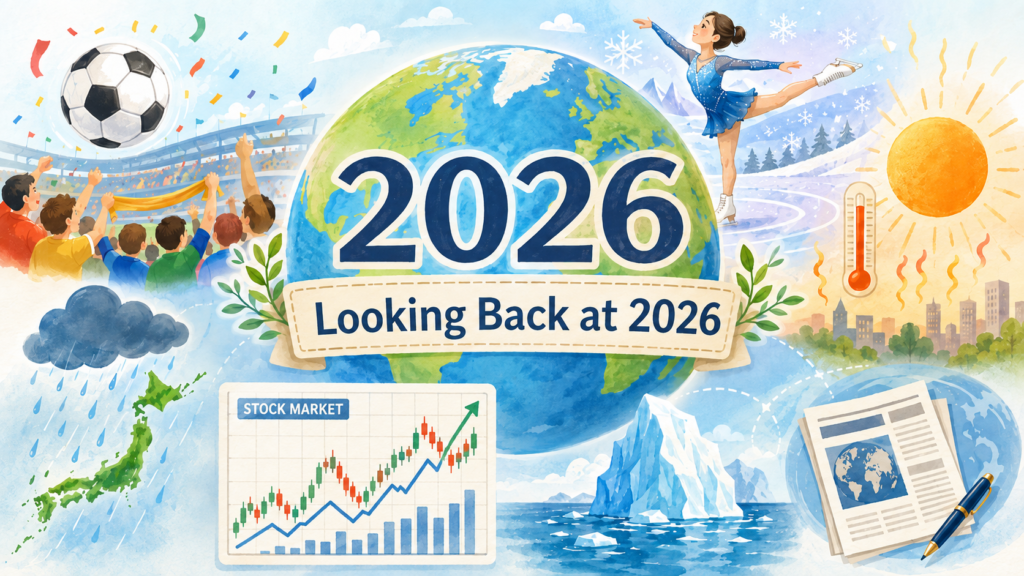
In August, record-breaking heavy rain hit multiple places around the world — Japan (Chiba, Ishikawa, and other prefectures), South Korea (Geoje saw what was called “once-in-200-years” rainfall), and China (over 60 deaths from heavy rain in August alone). This kind of “dump everything on one small area at once” downpour seems to be happening everywhere lately, and a lot of people probably felt climate change in a very physical way this month.
Then on August 26, a major disaster struck. Near the Nepal–Tibet (China) border, an entire mountain glacier collapsed, and the resulting mass of ice swept down the valley into the river system, triggering a massive debris flow and flooding. The scale was so enormous that it was initially mistaken for an earthquake. As of the end of August, the combined death toll across both countries had passed 800 (734 in Nepal, 16 in China), with roughly 3,044 people still missing — numbers almost too large to take in. Search and rescue efforts are still ongoing.
That same month, the dispute over the ICC (International Criminal Court) also widened. In short, here’s the shape of it: the U.S. has imposed sanctions (asset freezes, entry bans) on ICC judges and its president (Tomoko Akane, who is Japanese), arguing that the Court is unfairly targeting the U.S. and Israel. In response, U.S. human rights groups have sued, arguing the sanctions themselves are unconstitutional. Neither the U.S. nor Israel is even a member of the ICC, which raises the question of why they’re pushing back this hard — a debate that’s still far from settled.
June–July: A Summer That Brought the World Together
June and July brought the 2026 FIFA World Cup — the first edition with 48 participating nations, spanning three North American host countries over more than a month. It became more than a sporting event; it pulled in questions of immigration, security, and politics on a massive international scale.
Around the same time, the “U.S./Israel vs. Iran” war that had been going since late February reached a turning point. On June 17, President Trump and Iran’s President Pezeshkian signed a memorandum to end hostilities, beginning a shift toward ceasefire. But it’s too early to call it “over” — hundreds of thousands of people remain displaced in Lebanon and other surrounding areas, and the humanitarian situation there remains dire.
A bit earlier, on June 10, Iran declared it would fully close the Strait of Hormuz — the critical route through which much of the world’s oil tankers pass. The prospect of the world’s energy flow grinding to a halt made for a genuinely nerve-wracking moment.
These months also saw major developments in AI. One was the standoff between Anthropic and the Pentagon over how far AI should be allowed into military and domestic surveillance use — a topic that would have sounded like science fiction a few years ago, now fully a live political issue.
The other was a wave of AI IPO filings. On June 1, Anthropic, and on June 8, OpenAI, each confidentially filed for an IPO with the U.S. SEC. The implied valuations were staggering for AI startups — around $965 billion for Anthropic and $852 billion for OpenAI. (SpaceX, for reference, actually went public a bit earlier, on June 12.) As of late August, though, neither Anthropic nor OpenAI has actually completed its IPO. Anthropic may list as early as this year, while OpenAI is reportedly considering pushing back to 2027 given market instability — so how this AI IPO race plays out is still an open question.
February–March: Geopolitical Shockwaves
From February 6 to 22, Italy hosted the Milan-Cortina Winter Olympics. Even at the opening ceremony, political tension around Ukraine, Israel, and the U.S. was visible in the crowd’s reactions.
Then, right after that, on February 28, the U.S. and Israel launched a large-scale military attack on Iran, starting a war. Nuclear and military facilities were struck, and Iran retaliated. Iran’s Supreme Leader, Ali Khamenei, was reportedly killed in the initial strikes — one of 2026’s defining geopolitical stories.
Around the same time as the Iran attack, Israeli forces also expanded their military operations in neighboring Lebanon, seizing a key stronghold for the first time in 26 years. Even with a nominal ceasefire in place, fighting didn’t actually stop, and by April, Lebanon’s death toll had reportedly passed 2,500. It’s been overshadowed by the Iran war headlines, but the scale of it shouldn’t be overlooked.
The situation in Gaza also remains stalled. Hamas, which effectively controls Gaza, has rejected the peace plan put forward by the Trump administration, and there’s still no visible path toward a ceasefire or reconstruction. It tends to get buried under bigger headlines, but it’s another story worth remembering is “still ongoing.”
January: A Turbulent Start to the Year
Even early January wasn’t quiet. President Trump renewed demands to acquire Greenland, raising tensions with Denmark and other NATO countries.
Then on January 3, U.S. forces struck Venezuela and captured sitting President Maduro along with his wife, taking them to the United States. Reactions split between those celebrating the removal of an “authoritarian leader” and those calling it a violation of international law for one country to seize another’s president this way.
Dizzying, Honestly
Just laying it all out like this is enough to make my head spin. Honestly, there were a few things where I paused and thought, “wait, did that happen this year?” One shocking headline after another keeps overwriting my memory of the last one.
The footage from the Nepal-Tibet debris flow in particular was devastating to watch. I remember feeling a lingering sense of helplessness for a while afterward.
Between a Small Life and a Big World
Even setting all that aside, the world keeps changing in ways we don’t always register unless the news tells us. It’s given me a lot to think about in my own daily life.
Take this AI era, for instance — knowing how much water and electricity go into running the servers that power AI makes me want to conserve where I can. So I’ve taken to hanging laundry outside to dry, even though it’s technically against the rules where I live in California (something about “disturbing the neighborhood’s appearance”) — though my patio isn’t visible from outside, so I get away with it. Towels get a bit stiff air-dried, so I still use the dryer for those. I’ve also tried to water my garden less, which meant losing some of the herbs in my front yard. And I’ve been trying to cut back on casual chit-chat with AI, too.
But no matter how conscientiously ordinary people try to live, if a bomb goes off somewhere because of a war, the environmental damage from that single event dwarfs anything any of us could offset through personal effort. The energy used is on a completely different scale. And nuclear weapons — something that, if ever used, could make the planet uninhabitable, could mean the end of humanity itself — are still being built, with talk of “everyone should have some” almost normalized.
There’s a real sense, again this year, that the world is reshaping itself in ways completely disconnected from what ordinary people actually want.
That feeling of helplessness again. But I don’t want to leave it there. If this moment, at the end of summer 2026, can be a quiet nudge to sit with these questions a little longer, I think that would be enough.