
I finally watched The Wolf of Wall Street, starring Leonardo DiCaprio, because it was available on Amazon Prime at no extra charge.
There were occasional commercials, but considering the movie is almost three hours long, they actually made convenient bathroom breaks.
The movie is based on the story of Jordan Belfort, a real-life stockbroker who made a fortune selling penny stocks — extremely cheap, speculative stocks — for huge commissions.
His firm also engaged in “pump and dump” schemes, manipulating stock prices and making enormous profits in the process.
Money, women, drugs, mansions, yachts — the movie is basically three hours of greed and excess.
And, of course, hiding money overseas once the authorities started closing in.
I had heard plenty about this movie before watching it, so none of that was exactly a surprise.
What did surprise me was how much of the basic story was based on real events.
Belfort eventually pleaded guilty to securities fraud and money laundering. Yet he actually spent only 22 months in prison, partly because he cooperated with authorities and provided information about other people involved in the operation.
Twenty-two months.
After watching everything that happens in the movie, I couldn’t help thinking:
That’s it?
Today, Belfort works as a motivational speaker, sales trainer, author and business consultant.
Life is strange.
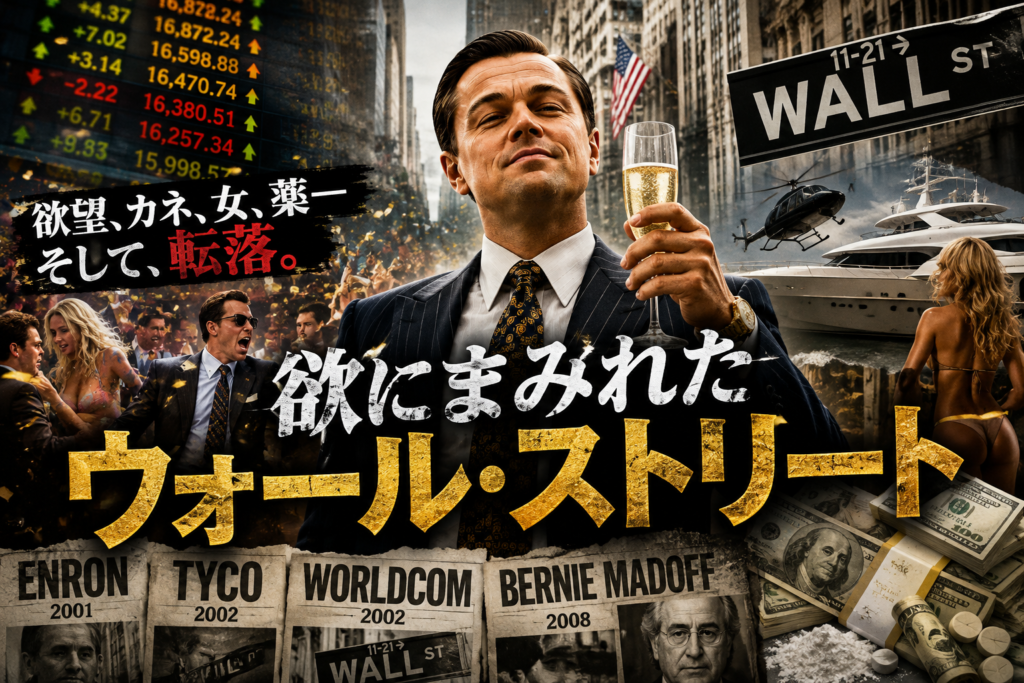
It Reminded Me of All Those Financial Scandals
Watching the movie also reminded me of all the major corporate and financial scandals from the early 2000s.
Back then, I used to read an actual newspaper every day.
(I really did subscribe to a newspaper. Remember those days?)
And I watched TV news regularly, too.
I remember constantly hearing names like Enron, WorldCom and Tyco.
I knew they had done something very bad involving money and accounting, but honestly, I never completely understood what they had actually done.
More than twenty years later, I decided to ask ChatGPT to explain them to me one by one.
Enron — 2001
In very simple terms, Enron made a company that was actually in serious financial trouble look like an extremely successful and profitable business.
One of the most notorious methods involved SPEs — Special Purpose Entities.
Enron moved debt and losses into separate entities so that they did not appear in the company’s main financial statements in the same way investors might have expected.
In reality, Enron still carried substantial economic risk, but its financial statements made the company look much healthier than it really was.
The company also aggressively used mark-to-market accounting, recognizing estimated future profits from long-term contracts before those profits had actually been earned.
Eventually, the whole thing collapsed.
And Enron’s auditor, Arthur Andersen — at the time one of the largest accounting firms in the world — was pulled into the scandal as well and ultimately ceased operating as a major audit firm.
The scandal changed the accounting profession itself.
Tyco International — 2002
Tyco was a somewhat different type of scandal.
Top executives, including CEO Dennis Kozlowski and CFO Mark Swartz, were accused of using unauthorized loans, compensation arrangements and company money to enrich themselves.
Their extravagant personal spending became part of the story as well.
In a way, this one feels particularly Wolf of Wall Street-like:
So much money was flowing around that people’s sense of what was normal seemed to disappear completely.
WorldCom — 2002
WorldCom is especially interesting if you know even a little accounting because the basic idea behind the fraud sounds almost ridiculously simple.
Expenses that should have been recorded as expenses were instead recorded as assets.
WorldCom was a telecommunications company with enormous network-related costs.
If a cost that should reduce this year’s profit is instead put on the balance sheet as an asset, current expenses become smaller.
And suddenly a company that is losing money can appear profitable.
The journal entries themselves weren’t necessarily complicated.
But when the amounts involved are measured in billions of dollars, a seemingly simple accounting entry can completely change the financial picture of a company.
Bernie Madoff — 2008
Then there was Bernie Madoff.
Madoff was a highly respected figure on Wall Street who had even served as chairman of Nasdaq.
Behind that respectable image, however, he was operating what became one of the largest Ponzi schemes in history.
Money coming in from new investors was used to pay earlier investors, creating the appearance that the investment strategy was consistently generating returns.
Customers looked at their statements and saw remarkably steady investment gains.
But the investment operation they thought was producing those gains largely did not exist.
When the 2008 financial crisis caused investors to request large withdrawals, the scheme could no longer continue.
Madoff was eventually sentenced to 150 years in prison and died while incarcerated.
And Yet, the Stock Market Keeps Going Up
After reading all of this, it would be easy to conclude:
The financial world is terrifying. Stay away.
But strangely enough, The Wolf of Wall Street made me think about something else, too.
Belfort and the people involved in these other scandals became consumed by greed. Some accumulated extraordinary wealth for a while and eventually came crashing down.
But there are also millions of people who have invested perfectly legally and patiently for decades and gradually built substantial wealth.
In fact, obviously, there are far more of those people.
The U.S. stock market has experienced crashes, recessions, financial crises, wars, inflation and countless predictions of disaster.
And yet, over very long periods, the broad market has continued to rise.
Of course, that doesn’t mean every individual stock rises.
Plenty of companies disappear completely.
And there is absolutely no guarantee that future returns will look like past returns.
Still, someone who steadily invested in a diversified index such as the S&P 500 over many years has participated in the long-term growth of American businesses.
And while watching this movie, I started thinking about the difference between:
people who work for money
and
people whose money also works for them.
That difference can become enormous over decades.
Every month, I work, a modest paycheck arrives in my bank account, and a huge chunk of it immediately disappears into rent.
Then I go grocery shopping and look at the prices before deciding what to buy.
Meanwhile, people who already own substantial assets can watch those assets grow when the market rises.
At some point while watching the movie, I thought:
This is ridiculous. Why am I doing this?
That feeling stayed with me for about two days after I finished the movie.
There were some other things going on in my life at the time, too, so the movie probably wasn’t entirely responsible.
Still.
Of course, the answer is not to dump all my savings into some penny stock and hope to become rich overnight.
That would probably just put me on the other side of The Wolf of Wall Street — as one of the customers being sold the dream.
Maybe the more realistic lesson is much less exciting:
Take a small portion of the money I earn through work and gradually turn it into money that can work alongside me.
No yacht.
No Swiss bank account.
No pump and dump.
Just a little bit at a time.
Somehow, one movie about outrageous greed ended up making me think quite a lot about ordinary work, investing, and money.