
Making Money From a Weak Yen — Then Blaming Japan When the Yen Gets Stronger?
Suddenly, the yen is getting stronger.
Why?
But actually, even before that, I had been wondering for years:
Why has the yen been so weak in the first place?
Of course, there are many reasons behind the weak yen, but one major factor has been the large interest-rate gap between Japan and countries such as the United States.
Japan kept interest rates extremely low for a very long time, while interest rates in the U.S. were much higher.
So investors came up with a pretty obvious idea:
Why not borrow or raise money cheaply in yen, convert it into dollars, and invest it somewhere that offers a higher return?
And when a lot of investors sell yen to buy dollars, that activity itself can put downward pressure on the yen.
If the yen keeps weakening, that’s even better for someone who funded their investment in yen.
When I learned about this, my reaction was basically:
Oh. So that’s another thing they’ve been doing.
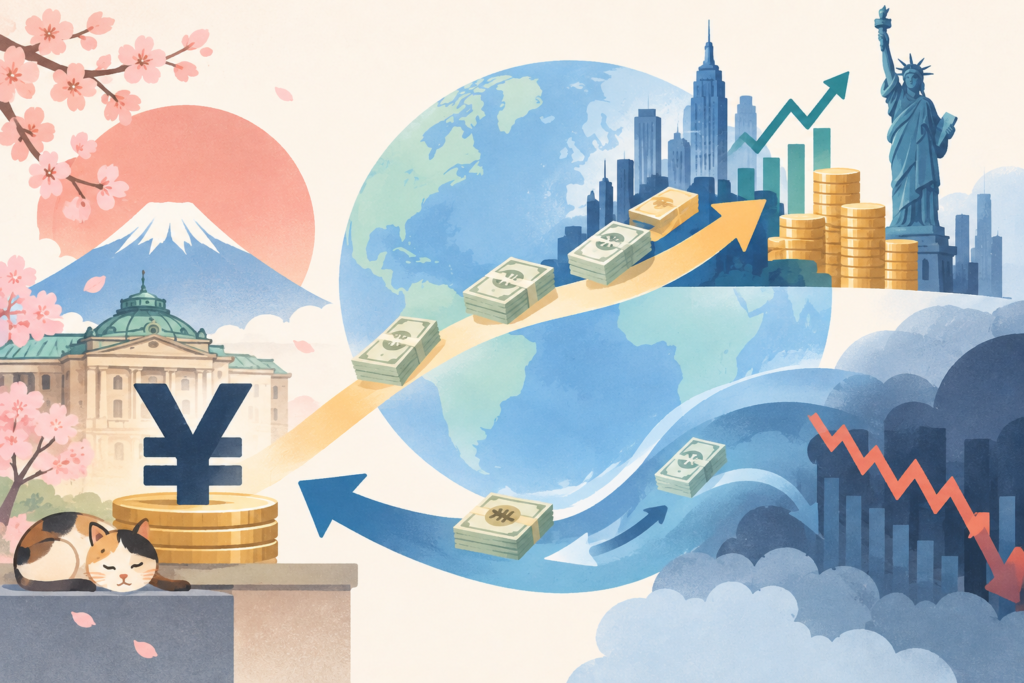
I’ve Been Learning More About How Finance Actually Works
I’ve actually owned small amounts of ETFs and individual stocks for more than ten years.
Not that my wealth has dramatically multiplied as a result. (^_^)
And I certainly wouldn’t call myself a financial expert.
Whenever I saw unfamiliar financial terms in the news, my reaction was usually:
“What’s that?”
And then I would move on.
But after watching the enormous rise in the S&P 500 and technology stocks in recent years — along with occasional headlines suggesting that perhaps things are getting a little overheated — I’ve become interested in the stock market again.
So lately, whenever I come across something I don’t understand, I ask ChatGPT to explain it to me.
And quite often I end up thinking:
Wait… THAT’S how it works?
So I thought I’d start writing about some of the things I’m learning along the way.
Thing I Recently Learned #1
Global Investors Borrow in Yen to Invest Elsewhere
Apparently, this really is a thing.
Because Japan maintained extremely low interest rates for decades, the yen became an attractive funding currency for global investors.
The basic idea is:
Raise or borrow money cheaply in yen.
Convert the yen into dollars or another currency.
Then invest that money in U.S. bonds, stocks, or other assets offering higher potential returns.
This is called the yen carry trade.
And it’s definitely not something that started yesterday.
The yen has been used as a low-cost funding currency in global financial markets for decades, particularly since Japan entered its era of ultra-low and eventually zero interest rates.
One important clarification:
This does not necessarily mean that hedge funds are walking into the Bank of Japan and borrowing piles of yen directly.
Yen funding can come through bank loans, but sophisticated investors can also create effectively similar positions through FX swaps, forwards, derivatives, and other financial instruments.
There are apparently quite a few ways to do this.
Finance people are creative.
Thing I Recently Learned #2
What Is Leverage?
This is another word that appears constantly in financial news.
In very simple terms, leverage allows you to control more money than you actually have by using borrowed funds or similar financial arrangements.
Suppose you have $10,000.
Normally, you could invest $10,000.
But imagine that through borrowing you control $50,000 worth of investments instead.
That’s 5-to-1 leverage.
If the investment rises 10%, you’ve gained $5,000.
That’s a 50% gain relative to your original $10,000.
Great when everything is going up.
Sounds wonderful.
Or perhaps I should say:
Sounds a little like gambling.
Because it works just as impressively in the opposite direction.
If that $50,000 investment falls 10%, you’ve lost $5,000.
Half of your original money is gone.
And if prices fall far enough, the investor may receive a margin call requiring additional collateral.
If they can’t provide it, positions may have to be liquidated.
So they sell.
Prices fall further.
That puts pressure on another leveraged investor.
That investor sells too.
Sell → prices fall → somebody else has to sell → prices fall again.
And suddenly something that looked perfectly manageable can become a chain reaction.
Now Combine Leverage With the Yen Carry Trade
This is where the two stories come together.
Raise money cheaply in yen.
Use that money to buy foreign assets.
Then add leverage.
As long as the yen remains weak and asset prices keep rising, everything looks wonderful.
But then the Bank of Japan starts raising interest rates.
The yen begins strengthening.
And suddenly the situation changes.
Investors who funded positions in yen eventually need yen to close or repay those positions.
That can create something like this:
Sell foreign assets
↓
Buy back yen
↓
The yen strengthens further
↓
Other carry traders come under pressure
↓
They sell assets too
That’s the unwinding of the yen carry trade.
And we got a pretty dramatic demonstration of what that can look like in August 2024.
August 2024: Japanese Stocks Went BOOM — in the Wrong Direction
On August 5, 2024, the Nikkei 225 fell an astonishing 12.4% in a single day.
It was one of Japan’s biggest stock-market declines since Black Monday in 1987.
Of course, the yen carry trade wasn’t the only reason.
Weak U.S. employment data had already raised recession fears, while concerns about expensive stock valuations were also weighing on markets.
Then came a stronger yen, carry-trade unwinding, and leveraged investors reducing their positions.
Japan’s TOPIX also fell roughly 12%.
The S&P 500 fell about 3% that day, while European stocks declined considerably less.
In other words, markets around the world were affected.
But Japan itself got absolutely hammered.
Markets then recovered surprisingly quickly. By the end of that week, the S&P 500 had recovered its Monday losses, while TOPIX had recovered much of its decline.
And Then It’s “The Bank of Japan Disrupted Global Markets”?
This is the part that bothers me a little.
Japan kept interest rates extremely low for years.
Global investors took advantage of those rates to obtain cheap yen funding.
They used that money to invest in assets elsewhere.
Some added leverage on top of it.
Then the Bank of Japan finally tries to move interest rates toward something resembling normal.
The yen rises.
Carry trades begin unwinding.
Global markets wobble.
And suddenly the explanation becomes:
“The Bank of Japan’s rate hike disrupted global markets.”
Wait a minute.
Who decided to use Japan’s ultra-low interest rates as a source of cheap funding for global speculation in the first place?
The Bank of Japan didn’t exactly announce:
“Please borrow our cheap yen, add a bunch of leverage, and use it to buy assets around the world.”
There’s nothing inherently illegal about investing based on differences in interest rates.
From an investor’s perspective, it may be perfectly rational.
But when these trades become enormous, their unwinding can shake markets around the world.
And in 2024, Japan itself suffered one of the biggest stock-market hits.
So reducing the whole story to:
“Japan raised interest rates.”
feels a little incomplete to me.
Is This Really Japan’s Problem — or a Problem With the Financial System?
The more I learn about modern finance, the more I keep coming back to one question:
Why does everyone need to borrow so much money to invest?
Buying stocks with your own savings makes sense to me.
You buy something.
It goes up, you make money.
It goes down, you lose money.
Simple enough.
But modern finance can look rather different.
Find the cheapest currency in the world to borrow.
Convert it into another currency.
Invest the money somewhere else.
Add leverage.
Make enormous profits while asset prices are rising.
And when everything reverses, the consequences don’t necessarily stay with the investors who took the risk.
The selling can spread through financial markets around the world.
At that point, I have to wonder whether this is really a “Japan interest-rate problem.”
Or whether it’s a broader problem with a financial system that constantly searches for cheap money and then uses debt and leverage to inflate asset positions.
The more I learn about finance, the more it seems to operate in a very different world from the one I’m familiar with:
Work. Save some money. Invest whatever is left over.
Apparently, there’s a whole other game going on.
And now, with the yen strengthening again, people are once again talking about the possibility of another yen carry-trade unwind.
Nobody knows exactly how large these positions really are, particularly because some of them are created through derivatives and other instruments that are difficult to measure.
So what happens this time?
For now, I think I’ll just keep watching the market without borrowing money or using leverage.
And if stocks fall enough, maybe I’ll buy a little. 😂

A Little Something for Your Desk
If I’m going to spend this much time reading about markets, interest rates,
and the yen carry trade, I might as well have a cute keyboard. 😅
Check it out on Amazon