
Around Los Angeles, overall prices rose by roughly 29% between 2020 and the summer of 2026.
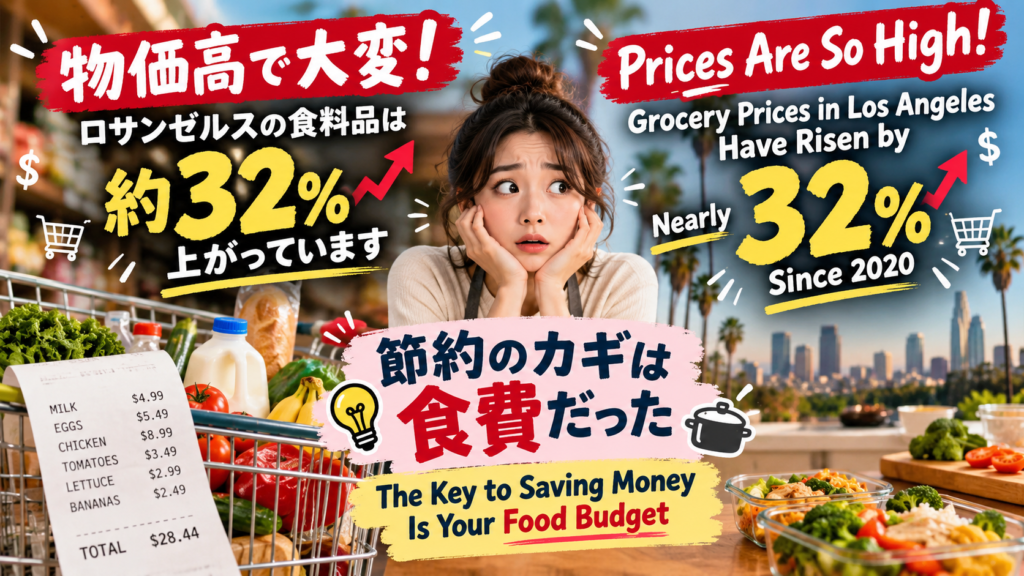
Groceries alone went up by about 32%.
In other words, $100 worth of groceries in 2020 would cost roughly $132 today.
So if you find yourself standing in the supermarket thinking,
“Wasn’t this a lot cheaper just a few years ago?”
No, you’re not imagining it.
For an ordinary person like me, one of the easiest ways to defend the household budget right now is surprisingly simple:
Buy fewer meals outside the home and actually use up the food you buy.
Not glamorous.
Not exciting.
But while we have very little control over rent, insurance premiums, or gasoline prices, food is one area where we still have some room to make adjustments.
And cooking at home can be better for your health, too.
So maybe cooking — and yes, cleaning up afterward — has become one of the more useful survival skills in this era of inflation.
Cancel unnecessary subscriptions? What if I don’t have any?
One of the most common pieces of money-saving advice is:
“Start by canceling subscriptions you don’t use.”
Fair enough.
Netflix. Spotify. Some mysterious app you forgot you signed up for. Some membership you barely remember joining.
But what if you’re already thinking:
I don’t have a bunch of unnecessary subscriptions.
That’s pretty much where I am.
So what is one area of everyday spending that can still be adjusted fairly quickly?
Food.
Especially in the U.S. right now, it’s not unusual to buy a simple sandwich and a drink and suddenly realize:
“Wait. This is $20 for one person?”
We’re not talking about fine dining here.
It’s lunch.
Then there’s tax — and sometimes tip.
You finish eating and think,
“What exactly did I just spend $20 on?”
Inflation since 2020 has certainly been painful, but historically, the 1970s were even more dramatic.
In the Los Angeles area, prices rose by roughly 54% in just five years between 1975 and 1980.
By comparison, prices increased by only about 7% between 2010 and 2015.
So after years of relatively mild inflation, we seem to have entered an era again where price increases are something people can actually see and feel.
And yes, energy had a lot to do with the inflation of the 1970s as well.
Inflation from the first oil shock had not fully settled down when loose monetary policy and inflation expectations became entrenched — and then the second oil shock hit.
In California, most groceries are also free from sales tax
One nice thing about living in California is that most basic groceries — such as meat, vegetables, and dairy products — are generally not subject to sales tax.
That helps.
Buy prepared food outside the home, and not only is the food itself more expensive, but you may also be adding tax and tip.
At home, you have a lot more flexibility.
Use a little less meat.
Add more vegetables.
Throw in that leftover tofu.
Use yesterday’s rice.
The more expensive food becomes, the more those small choices begin to matter.
When you know how to cook, leftovers in the refrigerator become a meal
I grew up in Japan with a mother who cooked every day.
Most families around me seemed to do the same, so the idea of eating home-cooked meals was completely normal.
But once I became the person who actually had to cook every day, I discovered something:
It’s a lot of work.
Decide what to make.
Cut everything.
Cook it.
Eat it.
And then…
the dishes are waiting.
Fifteen minutes to eat.
Thirty minutes to cook.
Another fifteen minutes to clean up.
The math does not always feel terribly efficient.
At first I remember thinking,
“People really do this every single day?”
But after enough years, you get used to it.
Now I can open the refrigerator and find a little chicken, half an onion, some broccoli and an egg and think,
“Okay. That’s dinner.”
Japanese.
Chinese-inspired.
Mexican.
Italian.
American.
If I don’t know exactly how to make something, I look it up.
And now we can even ask AI:
“Here’s what I have in my refrigerator. What can I make?”
We live in convenient times.
American recipes: Who is eating all this food?
There is, however, one problem I encounter constantly when looking up American recipes.
The portions are huge.
Serves 6.
Serves 8.
Sometimes 12.
Who is eating all this?
How many people live in your house?
Are you throwing a party every night?
So I routinely cut recipes down to:
1/2.
1/4.
And occasionally,
1/8.
Because if I make the entire recipe, this is what happens:
Day 1: “This is delicious.”
Day 2: “Still pretty good.”
Day 3: “This again?”
Day 4: “……”
And eventually the leftovers become an archaeological discovery in the back of the refrigerator.
That isn’t saving money.
Buying food cheaply matters, of course.
But I think one of the most important parts of saving money on food is simply:
Don’t throw food away.
If I want dinner plus lunch the next day, I make about two meals’ worth.
If something freezes well, maybe I make a little extra.
That alone can dramatically reduce food waste.
Maybe “Americans don’t cook” is changing, too
After living in the U.S. for many years, my impression has always been that eating out and getting takeout are much more integrated into everyday life here than they were where I grew up in Japan.
I also remember watching older American TV shows where a woman cooking lovingly for her boyfriend might get teased with something along the lines of:
“What are you doing playing the perfect little housewife in this day and age?”
I seem to remember that kind of vibe in shows like Gilmore Girls, too.
And I understand it.
Cooking takes time.
Cleaning up is annoying.
If efficiency is the priority, it’s easy to think:
“Why not just buy something?”
But social media may be changing that culture a little.
Instagram, TikTok and YouTube are full of cooking creators.
“Three ingredients.”
“Ready in 10 minutes.”
“High protein.”
“One-pan meal.”
There are endless quick recipes.
Teenagers can see a healthy-looking recipe online and try making it themselves.
I get plenty of ideas from social media, too.
You no longer need to pull a giant cookbook off the shelf and study a full page of instructions.
Sometimes a 30-second video is enough to get the idea.
In that sense, learning to cook may actually be easier now than it used to be.
And then someone says, “Stop trying to save money and just make more money”
Whenever people talk about cutting expenses, someone inevitably says:
“Instead of pinching pennies, why don’t you focus on making more money?”
Yes, yes.
Obviously, earning more money would be wonderful.
But here’s the thing:
You can increase your income AND not buy a $20 sandwich every time you’re hungry.
These two ideas are not mutually exclusive.
If you spend thousands of extra dollars every year on food while proudly declaring,
“I don’t bother saving money. I focus on earning more,”
and then all that additional income disappears right back out the door…
well.
You haven’t really gotten very far.
Cooking at home also gives you benefits beyond saving money.
You know what went into your food.
You can use less salt.
Add more vegetables.
Control the amount of oil.
Avoid some unnecessary additives.
Use up leftovers.
And perhaps most importantly:
When you’re hungry, you can turn whatever is already in the house into actual food.
That is a surprisingly useful skill.
Saving money isn’t about deprivation. It’s about not paying more than you need to.
When people hear the word “saving,” they often imagine:
Giving up things they want.
Eating only the cheapest food.
Cutting out everything enjoyable.
But I think of it differently.
Saving money is a skill that helps you avoid paying more than necessary.
Instead of spending $20 outside, make something at home for a few dollars.
Don’t let the vegetables you bought rot in the refrigerator.
Don’t cook eight servings when you only need two.
Make enough for tomorrow’s lunch.
Check what’s already in the refrigerator before going grocery shopping.
None of these things is dramatic.
But when groceries have risen by roughly 30% since 2020, continuing to shop and eat exactly the same way naturally means spending more money.
You can’t easily lower your rent.
You don’t get to decide the price of gasoline.
And you certainly can’t call your insurance company and say,
“Things are a little expensive this month, so I’ll just pay half.”
But food is still one area where we have some control.
That’s why I think one of the most useful financial survival skills in an inflationary world may not simply be “learning to cook.”
It may be:
Learning how to use what you already have.
Cooking skills.
Cleanup skills.
Not glamorous.
Definitely not Instagram-worthy.
But they’re good for your body, good for your wallet, and once you learn them, you can use them for the rest of your life.
That seems like a pretty good investment to me.
